
Article - A1 - The Startup Dilemma - MedTech Death Valley
Medical device founders: Are you building a commercial product, or just an expensive prototype?
Most startups that fail or run out of money fall into the common trap. They treat compliance like a final exam you can cram for at the end.
By hiring a specialist early, you flip the script — saving hundreds of thousands in technical debt, avoiding 510(k) rejections, and protecting your runway.
👇 Stop the burn.
Approximately 75% of US medical device startups fail and never achieve commercial market launch or return capital to investors.
Unlike traditional software companies, medtech startups operate in a hyper-regulated environment where the average time to bring a 510(k) product to market spans 3 to 7 years, with an average cost exceeding $31 million (and over 77% of that capital spent directly on regulatory and FDA compliance activities). This exceptionally long, capital-intensive runway is why running out of cash due to regulatory delays is the primary terminal event for medtech companies.
📈 Statistical Breakdown of MedTech Startup Failures
Data compiled from industry analyses, including CB Insights and healthcare VC tracking, reveals the specific root causes of this 75% failure rate:
75% Overall Failure Rate: 3 out of 4 early-stage US medtech companies never achieve commercial success.
90% Pre-Market Mortality Rate: Separate operational studies indicate that up to 90% of medtech companies that fail do so before ever reaching the market, typically suffocating under high burn rates within their first two years due to a lack of regulatory prioritization.
38% Cash Depletion (The Symptom): General and medical startup data shows that roughly 38% of failures cite running out of capital as the final blow. However, in medical devices, this cash burn is directly linked to regulatory roadblocks, design rework, and extended FDA approval timelines.
90% First-Time Compliance Failure: Strikingly, testing data from compliance auditors like Intertek shows that over 90% of medical devices fail to comply with required safety standards on their very first submission, triggering massive, unbudgeted timeline delays.
MedTech Death Valley:
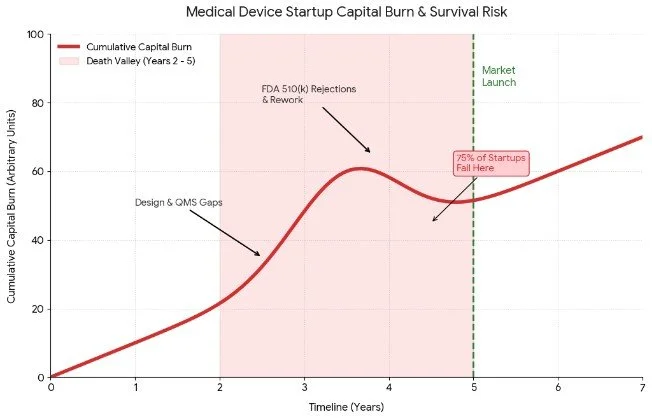
Key Points of Interest (POIs) in the Data:
Years 0–2 (The Prototyping Illusion): Capital burn is relatively low. Tech and engineering teams move fast, but frequently build "blind" without phase-appropriate QMS, creating a massive compliance debt.
Years 2–5 (The MedTech Death Valley): This is where the 75% failure rate peaks. Startups hit a wall trying to reverse-engineer documentation for design history files (DHF). The burn rate skyrockets here as technical teams sit idle during 12–24 month regulatory delays, or when hit with major FDA Additional Information requests.
Year 5+ (The Commercial Scale Barrier): Even after clearance, a lack of automated traceability and scalable quality systems prevents 60% of remaining companies from scaling production profitably.
Tech is Rarely the Killer: Only 6.5% of medical startups fail because their core technology didn't work. They fail because they mismanaged the sequence of regulatory, quality, and clinical validation needed to legally sell it.
Regulatory Debt is Exorbitant: Waiting to implement a QMS forces engineers to redo work. Since regulatory activities account for $24M+ of a device's $31M+ development cost, an unguided startup is essentially guessing on 77% of its budget.
This Data Predicts and emphasizes the need to engage a Specialist like MEDTECH-QCS to partner with and help assure that your company avoids these mistakes at all costs.
B. Camrell
Founder - Principal Consultant
MEDTECH-QCS
Note: The Article and associated research are from industry references, data, and information commonly available on the web.